


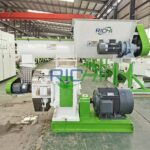


Steam conditioning is a decisive control point in the animal feed pelleting process. It determines whether mash feed enters the pellet mill die in a physical state suitable for compression, bonding, starch gelatinisation, microbial reduction, and stable production. In commercial feed mills, many pellet quality failures—low pellet durability, excessive fines, unstable pellet mill current, die blockage, high energy consumption, and inconsistent final moisture—are not caused primarily by the pellet mill itself, but by inadequate steam conditioning control before pelleting.
This report examines steam conditioning from the perspective of process engineering and feed mill operation. It analyses the interaction between steam quality, mash moisture, conditioning temperature, retention time, feed rate, particle size, formulation characteristics, and pellet mill load. Particular attention is given to the distinction between temperature control and true conditioning control. A conditioner that reaches the target temperature is not necessarily producing optimally conditioned mash. Effective conditioning requires stable heat transfer, controlled moisture addition, sufficient residence time, uniform steam distribution, and repeatable feed flow.
Industry practice and published feed processing research indicate that conditioning temperatures in the range of approximately 70–90°C are widely used in animal feed pelleting, with many commercial poultry and livestock feeds operating near 78–85°C. Under suitable moisture and retention conditions, steam conditioning improves pellet durability, reduces die friction, increases throughput, and contributes to hygienic feed production. However, excessive heat or uncontrolled steam addition can reduce enzyme recovery, increase water activity risk, cause die slipping, and reduce final product stability.
The objective of this report is to provide technical personnel with a practical framework for controlling steam conditioning as a measurable production system rather than as a simple steam valve or temperature setting.
1. Introduction
In the animal feed factory, steam conditioning occupies a critical position between mixing and pelleting. Mash feed leaving the mixer is still a loose, heterogeneous powder mixture composed of ground grains, protein meals, minerals, oils, additives, and sometimes liquid components such as molasses, fat, or water. Before this material can be compressed through the pellet mill die, it must be transformed into a warm, moist, plastic, and adhesive mass. This transformation is the function of steam conditioning.
For many operators, conditioning is still understood in a simplified way: steam is added until the material reaches a target temperature. In practice, this view is incomplete. Temperature is only one visible result of conditioning. The real objective is to create a controlled combination of heat, moisture, retention time, and particle surface modification. If steam is too dry, the material may heat rapidly but lack sufficient moisture for binding. If steam is too wet, the feed surface may become damp while the internal particles remain poorly conditioned. If residence time is too short, the mash may show a high outlet temperature but still have insufficient internal moisture migration. If the feed rate fluctuates, the steam-to-feed ratio changes continuously, resulting in alternating over-conditioned and under-conditioned material entering the die.
This explains why two feed mills using the same formula, same pellet mill model, and same die compression ratio may produce very different pellet quality. The difference is often not the pellet mill itself, but the stability and effectiveness of steam conditioning.
From an engineering point of view, steam conditioning must be treated as a controlled thermal-moisture process. The conditioner is not simply a conveying device. It is a heat exchanger, moisture transfer chamber, mechanical mixer, and pre-compression reactor operating continuously under variable raw material and production conditions.
2. Scientific Basis of Steam Conditioning
Steam conditioning works through the condensation of steam on cooler feed particles. When saturated steam contacts mash feed, it condenses and releases latent heat. This latent heat is the main source of rapid temperature rise. At the same time, the condensed steam becomes water absorbed by the feed matrix. Therefore, steam conditioning simultaneously introduces heat and moisture.
This dual function explains why steam is more effective than dry heating. Dry heat can raise temperature, but it does not provide the moisture needed for starch swelling, protein softening, fiber hydration, and particle bonding. In contrast, steam contributes both thermal energy and water, making it uniquely suitable for feed pelleting.
The major physical and chemical changes during conditioning include:
*- Softening of feed particles
*- Partial starch gelatinisation
*- Protein plasticisation
*- Improved particle adhesion
*- Reduced friction between mash and die wall
*- Increased microbial reduction
*- Improved pellet durability after cooling
Starch gelatinisation is particularly important in cereal-based feeds. When starch is exposed to heat and water, starch granules absorb moisture, swell, and partially lose their crystalline structure. During pelleting and cooling, this modified starch helps form solid bridges between particles. These bridges contribute to pellet hardness and pellet durability index, or PDI.
However, full starch gelatinisation is rarely achieved in ordinary livestock feed pelleting because conditioning time is usually short and moisture is limited. The process should therefore be understood as partial gelatinisation and surface modification rather than complete cooking. This distinction is important. The aim of ordinary feed conditioning is not to cook the feed completely, but to create enough plasticity and binding potential for stable pellet formation.
3. Temperature Control Is Not Equal to Conditioning Control
One of the most common mistakes in feed mill operation is to use conditioner outlet temperature as the only control indicator. Temperature is important, but it does not fully represent conditioning quality.
A conditioner outlet temperature of 82°C may represent very different material states depending on steam quality, feed rate, mash moisture, retention time, and formula composition. For example, a mash with 12.5% initial moisture and good-quality saturated steam may reach 82°C with adequate moisture absorption and good pellet quality. Another mash with only 9% initial moisture may also reach 82°C but remain too dry for optimal pellet binding. In this case, the operator sees the correct temperature, but the pellet mill receives poorly conditioned material.
Similarly, wet steam may raise both temperature and surface moisture quickly, but this moisture may remain on the particle surface rather than being uniformly absorbed. The result can be sticky mash, unstable die feeding, high water activity risk, and soft pellets after cooling.
Therefore, the technical definition of good conditioning should include at least four parameters:
*- Target outlet temperature
*- Target post-conditioning moisture
*- Stable steam quality
*- Sufficient and repeatable retention time
Only when these four parameters are controlled together can the conditioner produce consistent material for pelleting.
4. Steam Quality and Its Engineering Importance
Steam quality refers to the proportion of vapor in the steam supply. Good conditioning requires dry saturated steam, not wet steam and not excessively superheated steam.
Dry saturated steam is preferred because it condenses efficiently on feed particles, releasing latent heat and adding controlled moisture. Wet steam contains excessive liquid water droplets. These droplets do not behave like vapor. They tend to wet the feed surface unevenly, create lumps, increase conditioner buildup, and raise the risk of die blockage. Superheated steam, on the other hand, may carry heat but insufficient moisture, limiting starch hydration and pellet bonding.
In feed mill practice, poor steam quality is often caused by engineering defects in the steam supply system rather than by the conditioner itself. Common causes include poor boiler pressure stability, lack of pipe insulation, incorrect pressure reduction, condensate accumulation, malfunctioning steam traps, and absence of a steam separator near the conditioner.
A technically stable steam system should include:
*- Boiler with sufficient steam generation capacity
*- Main steam pipeline with insulation
*- Pressure reducing valve before the conditioner
*- Steam separator to remove entrained condensate
*- Steam trap installed at low points
*- Pressure gauge and temperature indicator
*- Control valve for automatic steam flow adjustment
*- Condensate drainage before startup
If condensate is not discharged before production, the first material entering the conditioner may receive liquid water instead of steam. This often causes startup instability, wet mash discharge, and pellet mill blockage within the first few minutes of production.
5. Conditioning Moisture and Pellet Quality
Moisture is the second core variable after temperature. In many feed mills, raw material moisture fluctuates significantly due to ingredient origin, storage conditions, season, and climate. As a result, the mash entering the conditioner does not have constant moisture. If the same steam setting is used for all batches, conditioning quality will inevitably fluctuate.
A typical animal feed mash may enter the conditioner with approximately 11–13% moisture. During steam conditioning, moisture may increase by 1.0–3.5 percentage points, depending on temperature rise, steam quality, and steam flow. After conditioning, the mash commonly reaches around 14–16% moisture before entering the pellet die. This moisture level is usually favorable for pellet binding, although the exact optimum depends on formula and product type.
The relationship between moisture and pellet quality is not linear. Too little moisture causes poor bonding and high die friction. Too much moisture causes die slipping, soft pellets, high final moisture, and microbial risk.
Table 1. Typical technical interpretation of conditioning moisture
| Conditioning condition | Expected production result | Technical interpretation |
|---|---|---|
| Low temperature + low moisture | High fines, low PDI, high motor load | Mash is under-conditioned and lacks plasticity |
| High temperature + low moisture | Hot but dry mash, unstable pellet quality | Temperature target reached but moisture is insufficient |
| Moderate temperature + suitable moisture | Stable current, good PDI, normal cooling | Preferred conditioning state |
| High temperature + excessive moisture | Soft pellets, die slipping, blockage risk | Surface wetting and over-conditioning |
| Wet steam + uneven moisture | Lumps, buildup, current fluctuation | Poor steam quality rather than formula failure |
This table shows why operators must avoid judging the conditioner only by outlet temperature. Moisture state determines whether the heat applied during conditioning can actually improve pellet formation.
6. Retention Time and Material Residence Behaviour
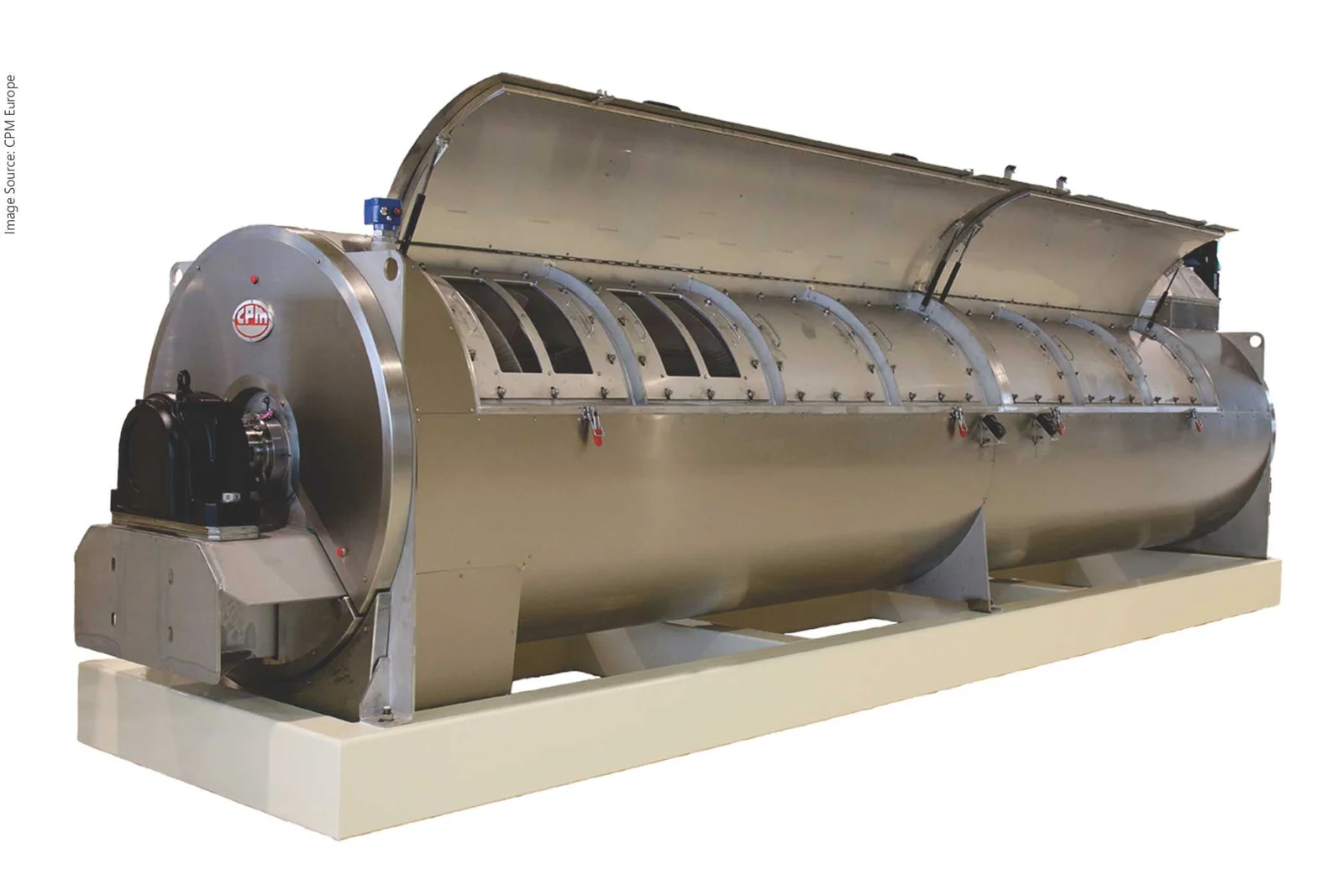
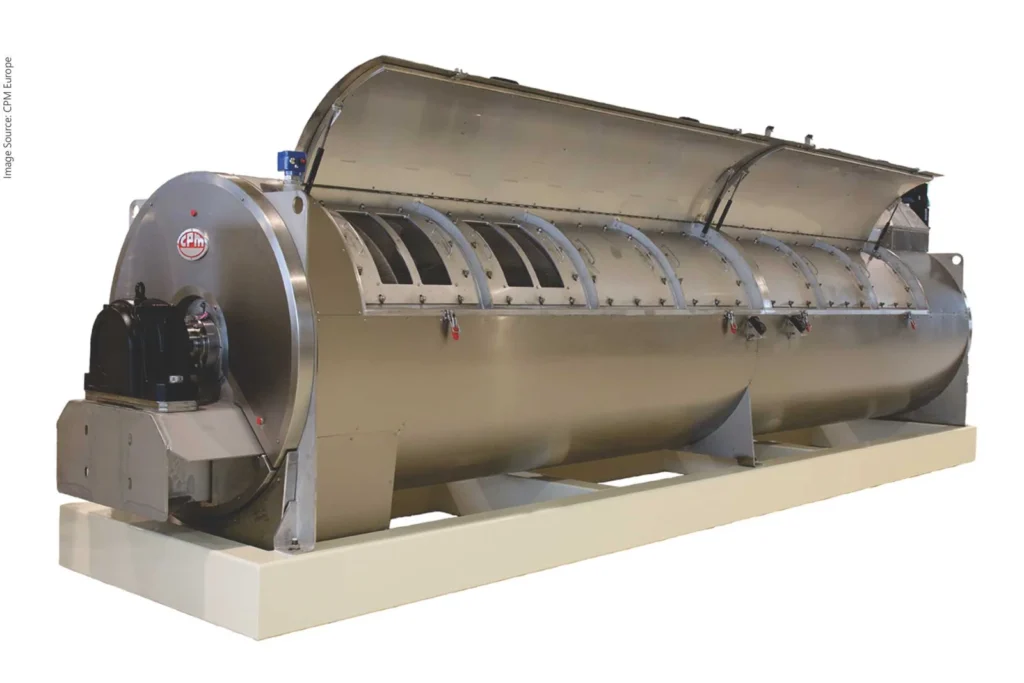
Retention time is the period during which mash remains inside the conditioner. It controls how long feed particles are exposed to heat, moisture, and mechanical mixing. In conventional single-shaft conditioners, retention time may range from approximately 15 seconds to 60 seconds. In long-term hygienic conditioners or double-pass systems, it may be extended significantly.
Longer retention time generally improves heat penetration and moisture absorption, especially for coarse particles, high-starch formulas, and hygienic feed. However, excessive retention time may reduce line capacity, increase nutrient degradation, and create buildup in sticky formulas.
The actual retention time is influenced by:
*- Conditioner length and diameter
*- Shaft speed
*- Paddle angle
*- Feed rate
*- Filling degree
*- Bulk density of mash
*- Formula flowability
A common technical error is to assume that the designed retention time of a conditioner is equal to the actual retention time during production. In reality, if the feed rate changes or paddles are adjusted incorrectly, the actual residence time can be much shorter or longer than expected.
A practical method for checking residence time is the tracer test. A small quantity of colored grain, mineral marker, or other visible tracer is introduced at the conditioner inlet. The time between tracer entry and first appearance at the outlet is recorded. The time between entry and disappearance is also recorded. This provides a residence time distribution rather than a single theoretical value.
For technical personnel, residence time distribution is more useful than nominal retention time because it reveals whether part of the material is short-circuiting through the conditioner. If some material passes too quickly, pellet quality becomes inconsistent even when the average temperature appears stable.
7. Interaction Between Formula Composition and Conditioning Response
Different formulas respond differently to steam conditioning. A conditioning standard suitable for broiler feed may not be suitable for piglet feed, fish feed, ruminant feed, or high-fiber feed.
Cereal-rich formulas usually respond well to steam conditioning because starch contributes to pellet binding. Corn, wheat, barley, and sorghum-based diets often show improved pellet durability when conditioning temperature and moisture are properly increased.
High-fat formulas are more difficult. Fat coats feed particles and reduces water penetration. If too much fat is added before conditioning, steam absorption becomes less effective and pellet binding decreases. In this situation, part of the oil should be shifted to post-pellet spraying if the production line allows it.
High-fiber formulas also require special attention. Fiber absorbs water slowly and may increase die friction if insufficiently conditioned. However, excessive steam can make fiber-rich mash bulky, sticky, or difficult to discharge. For ruminant feed, grass meal, alfalfa meal, palm kernel meal, and bran-rich diets, retention time and particle size are often as important as temperature.
Young animal feeds and enzyme-containing diets create another technical conflict. These feeds often require good pellet quality but contain heat-sensitive components such as enzymes, vitamins, probiotics, organic acids, or medicated additives. Higher conditioning temperature may improve pellet durability and microbial reduction, but it can also reduce additive activity. For these formulas, the technical solution is often not simply lowering temperature, but combining moderate conditioning, suitable die compression, fine grinding, post-pellet liquid application, and thermostable additives.
Table 2. Formula type and recommended conditioning focus
| Formula type | Main conditioning challenge | Recommended control focus |
|---|---|---|
| Broiler feed | PDI and production capacity | 78–85°C, stable steam, moderate retention |
| Pig feed | Hygiene and pellet durability | 75–85°C, controlled moisture, stable residence time |
| Piglet feed | Heat-sensitive additives | Lower thermal load, careful enzyme/vitamin protection |
| Ruminant feed | Fiber structure and die friction | Retention time, particle size, moisture balance |
| Fish feed | Water stability and starch modification | Higher moisture, longer conditioning, fine grinding |
| Shrimp feed | High water stability demand | Intensive conditioning, high binder activation, precise moisture |
| High-fat feed | Poor water penetration | Reduce pre-pellet fat, improve steam absorption |
| High-fiber feed | Slow hydration and high friction | Longer retention, controlled moisture, suitable die design |
8. Steam Conditioning and Pellet Mill Energy Consumption
The pellet mill is usually one of the largest energy consumers in a feed factory. A significant portion of pellet mill energy is used to overcome friction between mash and die holes. Steam conditioning reduces this friction by softening particles and increasing lubrication at the die interface.
When mash is under-conditioned, the pellet mill often shows the following symptoms:
*- High main motor current
*- Frequent current fluctuation
*- Reduced capacity
*- High die temperature
*- Roller slipping
*- Excessive die and roller wear
*- More fines after cooling
In contrast, properly conditioned mash flows through the die more smoothly. The main motor current becomes more stable, capacity increases, and pellet surface quality improves. This is why conditioning should be considered part of the energy management system of the feed mill.
However, excessive moisture can also reduce efficiency. If mash becomes too wet, the rollers may fail to grip the material properly. Instead of compression, slipping occurs. This may appear as unstable pellet length, soft pellets, reduced throughput, or sudden die blockage.
The technical goal is therefore to find the conditioning point where die friction is reduced but mechanical compression remains effective.
9. Steam Conditioning and Feed Hygiene
Steam conditioning contributes to microbial reduction, especially for Salmonella and other vegetative bacteria. Higher temperature and longer retention time improve hygienic effect. However, microbial control is not determined by conditioning alone. If pellets are re-contaminated during cooling, conveying, screening, or storage, the hygienic benefit of conditioning can be lost.
In hygienic feed production, the critical control concept should include:
*- Conditioner outlet temperature
*- Minimum retention time
*- Post-conditioning equipment hygiene
*- Cooler air quality
*- Finished product moisture
*- Finished product water activity
*- Prevention of condensation in storage
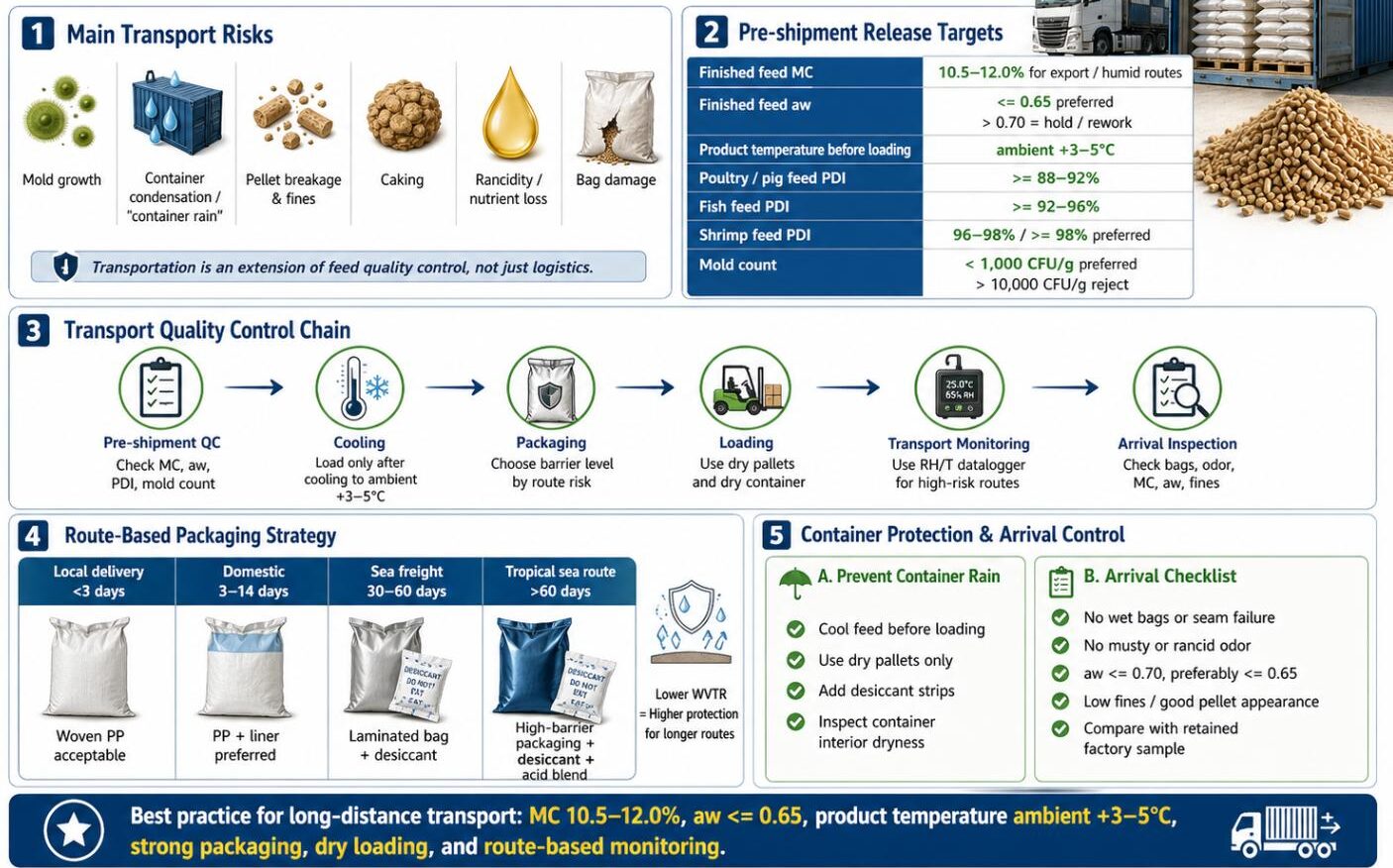
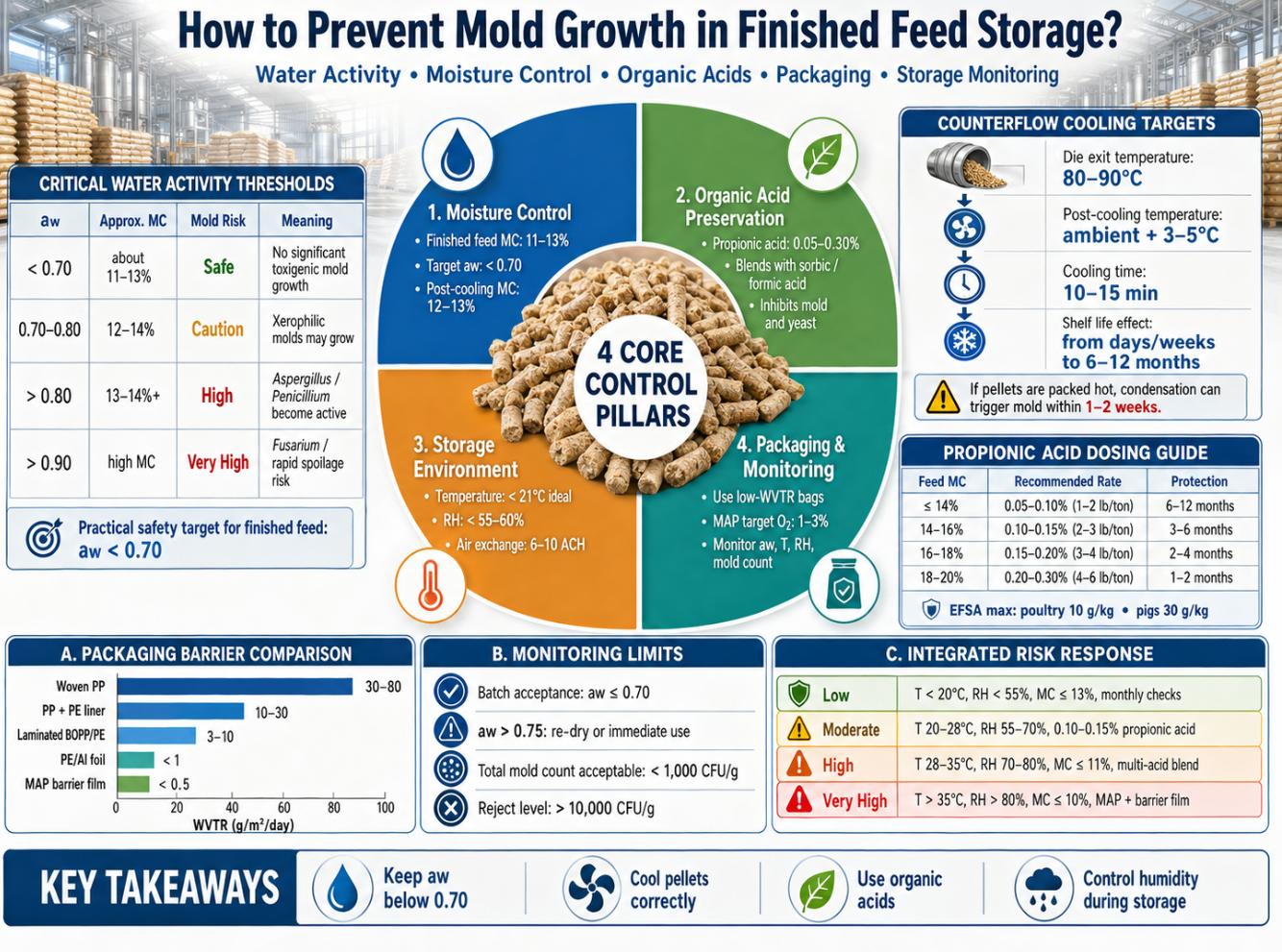
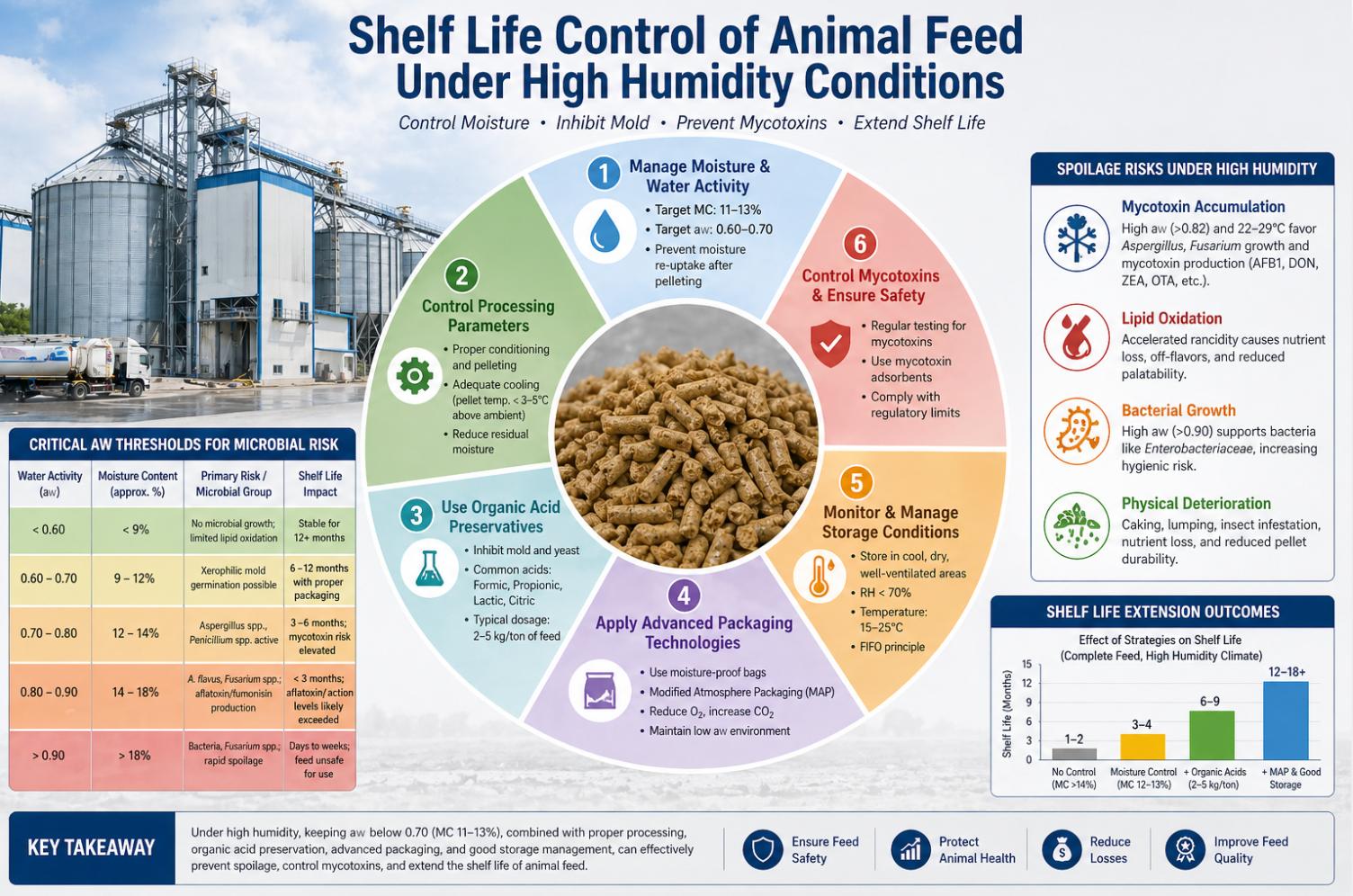
A feed may receive adequate thermal treatment but still become unsafe if it leaves the cooler too warm or too moist. Warm pellets entering a cooler warehouse can create condensation inside bags or bins. This localised moisture migration increases water activity and supports mould growth.
Therefore, conditioning must be coordinated with cooling. Higher conditioning temperature usually means higher cooling load. If cooler airflow and discharge control are not adjusted accordingly, final product quality becomes unstable.
10. Process Control Model for Steam Conditioning
A technically reliable steam conditioning system should not rely only on manual valve adjustment. The preferred control model is a combination of feed-forward and feedback control.
The feed-forward part responds to feed rate. When the feeder speed increases, steam demand increases. When feed rate decreases, steam demand decreases. This prevents large temperature deviation before it occurs.
The feedback part uses conditioner outlet temperature to correct steam flow. If actual temperature is below target, the steam valve opens. If temperature exceeds target, the valve closes.
The most advanced system also includes moisture measurement. Online or at-line moisture sensors can measure mash moisture before conditioning, conditioned mash moisture, and final pellet moisture after cooling. This allows the operator to distinguish between a true heat problem and a moisture problem.
Table 3. Recommended control variables for steam conditioning
| Control variable | Measurement point | Technical purpose |
|---|---|---|
| Feed rate | Feeder or production scale | Maintains stable steam-to-feed ratio |
| Steam pressure | Before conditioner valve | Ensures stable steam supply |
| Steam quality | Steam separator / inspection point | Prevents wet steam or excessive dryness |
| Conditioner outlet temperature | Conditioner discharge | Main feedback control variable |
| Mash moisture before conditioning | Mixer discharge | Determines steam and water demand |
| Mash moisture after conditioning | Conditioner outlet | Confirms actual conditioning state |
| Pellet mill current | Pellet mill motor | Indicates die load and conditioning effect |
| Hot pellet temperature | Pellet mill outlet | Evaluates die friction and thermal load |
| Final pellet moisture | After cooler | Confirms product safety and yield |
| PDI / fines ratio | Laboratory / quality control | Confirms final pellet quality |
This control structure turns conditioning from an operator-dependent process into a measurable production system.
11. Common Production Problems and Root Cause Analysis
11.1 Low Pellet Durability
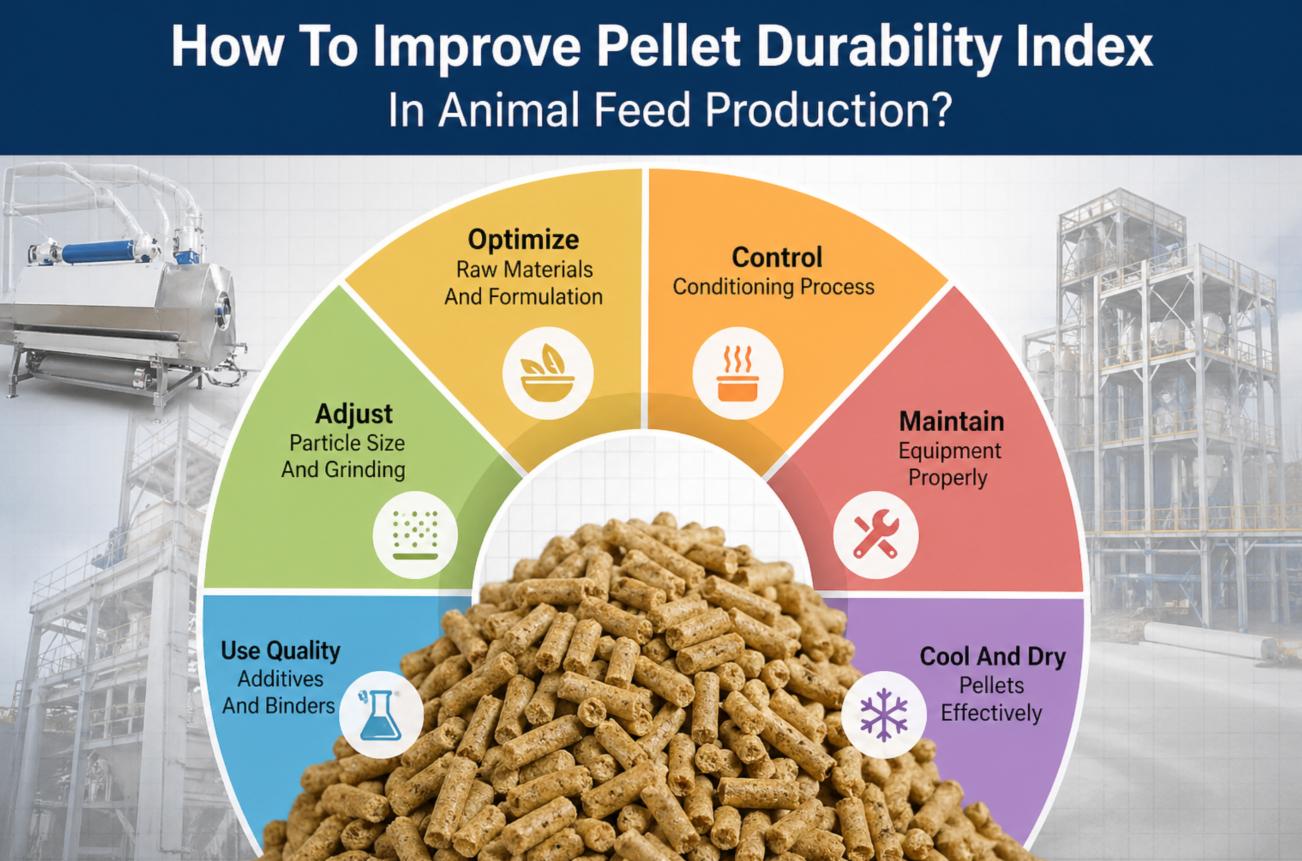
Low pellet durability is often attributed to die compression ratio or formula quality, but under-conditioning is frequently the actual cause. If the mash does not receive sufficient moisture and heat, particles cannot form strong bonds during compression. The resulting pellets break easily during cooling, conveying, screening, and transport.
The root causes may include low steam flow, poor steam quality, low initial mash moisture, short retention time, coarse grinding, excessive fat addition, or unstable feed rate.
The first corrective action should not be immediate die replacement. Technical personnel should first check conditioner outlet temperature, conditioned mash moisture, steam trap condition, feeder stability, and actual residence time.
11.2 High Fines After Cooling
High fines after cooling can result from weak pellet structure, over-drying in the cooler, or both. If pellets are already weak when entering the cooler, normal cooling air may break them further. If pellets are good at the pellet mill outlet but become brittle after cooling, excessive moisture removal or excessive cooling residence time may be the cause.
In this case, the operator should compare hot pellet condition and cooled pellet condition. This helps determine whether the problem originates from conditioning/pelleting or from the cooling stage.
11.3 Pellet Mill Current Instability
Current fluctuation is one of the most useful real-time indicators of conditioning stability. If feed rate is stable but current fluctuates sharply, the cause may be uneven steam distribution, wet steam, inconsistent mash moisture, conditioner buildup, or formula segregation.
Current instability should be treated as a process signal, not merely as an electrical problem. A stable pellet mill requires stable conditioned mash.
11.4 Die Blockage
Die blockage often occurs when the conditioner produces material that is either too dry and hard to compress, or too wet and sticky to pass through the die. Both under-conditioning and over-conditioning can cause blockage, but the corrective actions are different.
If the mash is dry, hot, and powdery, the solution is to improve moisture absorption and steam quality. If the mash is wet, sticky, and lumpy, the solution is to reduce wet steam, drain condensate, adjust steam pressure, or reduce liquid addition.
11.5 Soft Pellets and High Final Moisture
Soft pellets usually indicate excessive moisture, insufficient cooling, high fat level, poor die compression, or inadequate starch bonding. If soft pellets are also warm after cooling, the cooler is part of the problem. If they are cool but still weak, the issue may be over-conditioning, formula fat level, or poor die compression.
12. Practical Technical Standards for Feed Mills
Although each feed mill must establish its own formula-specific parameters, the following ranges are commonly used as engineering references.
Table 4. Practical steam conditioning reference ranges
| Product type | Conditioning temperature | Post-conditioning moisture | Retention time | Main control objective |
|---|---|---|---|---|
| Poultry feed | 78–85°C | 14–15.5% | 20–60 s | PDI, capacity, enzyme protection |
| Pig feed | 75–85°C | 14–16% | 30–60 s | Hygiene, durability, digestibility |
| Piglet feed | 65–80°C | 13.5–15% | 20–50 s | Additive stability, palatability |
| Ruminant feed | 65–80°C | 13.5–15.5% | 30–70 s | Fiber softening, die load control |
| Sinking fish feed | 80–95°C | 15–17% | 60–120 s | Water stability, starch activation |
| Shrimp feed | 85–100°C or higher | 16–18% | 90–180 s | Water stability, fine structure |
These values should not be treated as universal limits. They are starting points for process validation. The final control standard should be determined through production trials, PDI testing, final moisture analysis, animal nutrition requirements, and storage safety evaluation.
13. Recommended Operating Procedure
A scientific steam conditioning control programme should include routine measurement, process documentation, and corrective action logic.
Before production, operators should confirm that condensate has been drained from the steam line. Steam pressure should be stable, the separator and steam trap should be functioning, and the conditioner should be clean. The formula code, target temperature, expected moisture range, and production capacity should be confirmed before starting.
During startup, steam should be introduced gradually. Sudden full steam opening can cause wet mash discharge, especially when the conditioner body is still cold. The first material produced after startup should be checked carefully because it may not represent stable operating conditions.
During stable production, the operator should monitor feeder speed, conditioner outlet temperature, pellet mill current, hot pellet quality, and cooler discharge condition. If possible, conditioned mash moisture should be tested regularly. Any change in raw material batch, formula, die specification, or production rate should trigger renewed parameter verification.
During shutdown, steam should be stopped before feed flow is fully stopped, allowing the conditioner to discharge remaining material. This reduces the risk of wet material remaining inside the conditioner and hardening before the next startup.
14. Data Recording and Process Optimisation
Technical management requires data. Without data, conditioning control depends mainly on operator experience. A feed mill should establish a conditioning record for each major formula.
Recommended record items include:
*- Formula code
*- Raw material or mash moisture before conditioning
*- Feeder speed or actual production rate
*- Steam pressure before control valve
*- Conditioner outlet temperature
*- Conditioned mash moisture
*- Pellet mill current
*- Die specification
*- Hot pellet temperature
*- Cooler outlet temperature
*- Finished pellet moisture
*- PDI
*- Fines percentage
*- Operator adjustment notes
Over time, these records allow the technical team to identify the real optimum conditioning window for each formula. For example, one broiler feed formula may achieve best PDI at 82°C and 15.0% conditioned moisture, while another high-fat formula may perform better at 78°C with lower moisture and higher die compression. These differences cannot be solved by one universal setting.
Statistical process control can also be applied. If conditioner outlet temperature fluctuates more than expected, the team should investigate steam pressure, feed rate, and valve response. If final pellet moisture fluctuates while outlet temperature remains stable, the problem may be raw material moisture, cooler airflow, or wet steam.
15. Economic Significance of Steam Conditioning Control
Steam conditioning has direct economic value. Its effect is reflected in production capacity, energy consumption, pellet quality, moisture retention, die life, and customer complaint rate.
Poor conditioning increases cost through several mechanisms:
*- Lower pellet mill throughput
*- Higher electrical energy consumption per tonne
*- Higher fines and rework rate
*- Faster die and roller wear
*- More production interruptions
*- Greater risk of mould or storage instability
*- Reduced customer acceptance of pellet appearance
Good conditioning improves profitability by increasing the amount of acceptable product produced per hour and reducing mechanical stress on the pelleting system. Even a small improvement in PDI or reduction in fines can have significant commercial value in large-scale feed production.
For a feed mill producing hundreds of thousands of tonnes annually, conditioning stability is not a minor operating detail. It is a production economics issue.
16. Technical Conclusions
Steam conditioning is one of the most important control points in animal feed pellet production. It determines whether mash feed can be compressed efficiently into durable, stable, and safe pellets. The process should not be reduced to a simple temperature target. True conditioning control requires the coordinated management of temperature, moisture, steam quality, retention time, feed rate, formulation characteristics, and pellet mill response.
The main conclusions of this report are as follows:
1- Conditioner outlet temperature is necessary but insufficient. A feed may reach the target temperature while still being too dry, poorly hydrated, or unevenly conditioned.
2- Steam quality is a decisive engineering factor. Dry saturated steam supports efficient heat and moisture transfer, while wet steam causes surface wetting, buildup, die instability, and microbial risk.
3- Post-conditioning moisture is directly related to pellet durability and die performance. Too little moisture increases fines and energy consumption, while excessive moisture causes soft pellets, die slipping, and storage risk.
4- Retention time determines whether heat and moisture have enough time to penetrate the feed matrix. Actual residence time should be verified under production conditions rather than assumed from equipment design.
5- Formula composition changes the conditioning response. High-starch, high-fat, high-fiber, enzyme-containing, and aquatic feed formulas require different conditioning strategies.
6- Pellet mill current is a valuable real-time indicator of conditioning stability. Stable current usually reflects stable feed flow, steam flow, and mash physical condition.
7- Conditioning must be coordinated with cooling. Higher thermal and moisture input during conditioning increases the importance of controlled cooling and final moisture management.
8- The most reliable control strategy combines feed-forward steam adjustment based on feed rate, feedback control based on outlet temperature, and moisture verification through regular or online measurement.
In conclusion, steam conditioning should be managed as a precision engineering process. When controlled correctly, it improves pellet durability, production efficiency, energy use, feed hygiene, and product consistency. When poorly controlled, it becomes a hidden source of quality variation and production loss. For technical personnel, the essential task is to transform conditioning from an experience-based operation into a data-based, formula-specific, and continuously optimised control system.